
Finding Georgetown Residents
Georgetown Township has no one public household list. A search works best when it starts with the kind of fact already known. A street address can lead to the Ottawa County parcel record. A full name can lead to a recorded deed, a historical directory entry, or a court and vital-record custodian. Township materials add staff names, public meeting references, cemetery records, and address-keyed permits. Each source answers a narrower question. A parcel shows an assessed owner, not everyone at the home. A deed shows recorded parties and a date, not a present living arrangement. A historical register can place a person in the township at a particular time.
Use at least two independent records when names are common or the date matters. Georgetown's local history also uses Jenison and the older Jenisonville label, so try those place names when a catalog search comes up empty. County offices, the township clerk, the state voter system, and the history room offer different access channels when an online result is thin.
- Search the Ottawa County property roll by owner last name, parcel number, or house number and street name.
- Read the property address, mailing address, FinalPIN, and latest sale as separate fields.
- Use the parcel number or a recorded party name in the Register of Deeds index.
- For a dated family question, check the library history room, cemetery material, census links, or county vital indexes.
- When the record is not online, ask the custodian for counter inspection, a research-library search, or a Michigan FOIA route.
Georgetown Resident Records Custodians
Ottawa County keeps the core property, deed, vital, court, and tax systems used for Georgetown Township research. The Register of Deeds and county clerk offices are at the West Olive county complex, while the deeds research library offers a Grand Haven access point. Georgetown Township remains useful for its clerk, board material, staff directory, cemetery administration, and records connected to local permits. The Michigan Voter Information Center is a self-service registration tool, while a broader Qualified Voter File request follows a formal state process.
Ottawa Clerk/Register of Deeds
12220 Fillmore Street, Room 146
West Olive, MI 49460
616-994-4510
Ottawa Property Services
County property, tax, and GIS records
Georgetown assessing help: 616-846-8262
Treasurer: 616-994-4500
Georgetown Township Clerk
1515 Baldwin Street
Jenison, MI 49429
616-457-2340
County offices normally list weekday hours of 8 a.m. to 5 p.m., but the locations page reports recurring 2026 morning maintenance closures. Confirm hours before visiting a counter.
Georgetown Parcel Roll Search
Ottawa County Real Property Search is the most direct official starting point for a Georgetown address or assessed owner. Its basic form accepts an owner last name, segmented parcel number, or a house number with street name. It also allows active and inactive parcel choices. Georgetown's FAQ says county services have provided assessing since June 2024, which is why the county portal is the current first stop. Results can lead to Property Summary, tax details, sales history, split history, parcel reports, and the GIS map.
The form does not show a basic city or ZIP filter. Search with the number and street name as recorded, then use the parcel result to sort out township, postal, and school-district fields. An owner result is useful evidence for a property question, but a trust, estate, or organization can also be the listed owner.
| Property-search field | How it is used | Format note |
|---|---|---|
| Owner Last Name | Find an assessed owner | Text field |
| Parcel Number | Reach one property record | Segmented identifier beginning with 70 |
| House Number | Start an address search | Use with Street Name |
| Street Name | Match the property street | No city or ZIP field on the basic form |
| Active or Inactive | Include parcel status | Optional selection |
The county property search shown here places the owner, parcel, and address routes together.
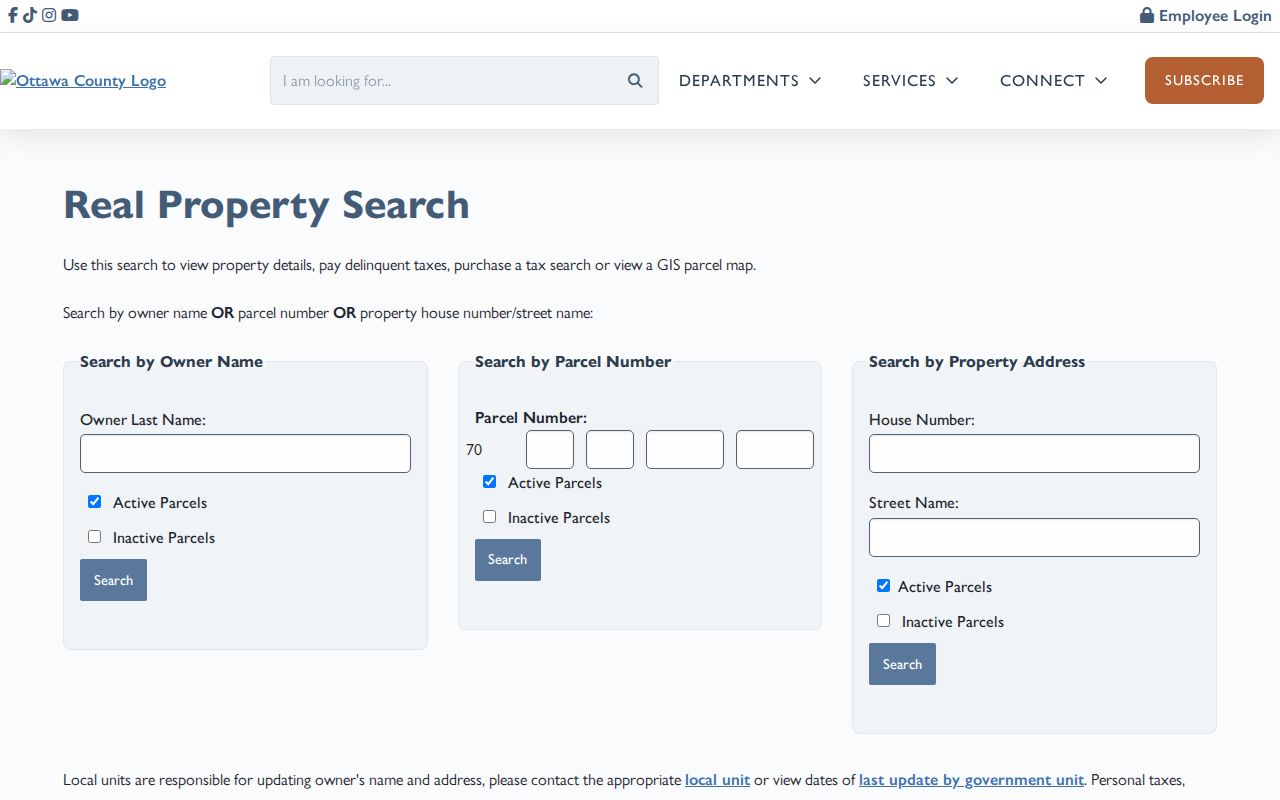
Those three routes make the parcel roll a practical first record when a person has a known name or a Georgetown Township street address.
Georgetown Parcel Address Clues
A Georgetown parcel has more than one address clue. The situs or property address identifies the physical parcel. The mailing address tells the county where tax correspondence goes, and it can be outside Georgetown Township or Michigan. The legal description is the deed-defined land description, often a lot and block or public-land-survey wording. The FinalPIN is the county parcel identifier that bridges the map, property summary, tax material, and many deed records. Keep these fields distinct when a name search produces a close but not exact match.
The public GIS map adds parcel boundaries, address components, subdivisions, roads, school districts, jurisdiction outlines, building outlines, aerial layers, and right-of-way or easement context. A parcel popup links back to Property Summary, Deeds Search, and a parcel-error question route. The map can select multiple parcel objects with a query or Ctrl-click, but the county does not document a public radius report. It is an address-to-record bridge, not proof of everyone in a household.
- Parcel
- A county-tracked piece of land with a PIN and property fields.
- Situs address
- The physical location of the parcel, separate from tax mail.
- Mailing address
- The correspondence destination supplied for the property record.
- Legal description
- The land wording used in a deed, plat, or survey record.
Note: A Principal Residence Exemption supports an owner-occupancy tax qualification, but it does not identify every member of a household.
Current Georgetown Resident Directories
Current Georgetown resident directories are really a group of limited public rolls. The property system lists assessed owners and property fields. The deed index lists people or entities named in recorded instruments. The township staff directory lists people performing public roles and has category, first-name, and last-name controls. Michigan's voter system supports an individual's own registration check, while a broader state file is requested through the Qualified Voter File process. Cemeteries, agendas, permits, and voluntary community resources can also supply dated leads, but they are not interchangeable lists.
| Georgetown source | What it can identify | Custodian | Access route |
|---|---|---|---|
| Property roll and GIS | Assessed owner, parcel, situs and mailing fields | Ottawa County | Public property portal and map |
| Recorded deed index | Parties, parcel links, recording dates, instruments | Register of Deeds | Free index; paid images |
| Township staff directory | Public officials and department contacts | Georgetown Township | Online category and name search |
| Voter records | Personal registration response or formal file fields | Michigan elections offices | MVIC or QVF request |
| Township cemetery records | Burial and plot leads | Georgetown Cemetery Office | Listing, grave photos, office, and GIS |
For a one-person identity question, a Georgetown Township resident lookup can combine a dated parcel, deed, court, or vital clue without treating one listing as final proof.
Georgetown Deed Index Trail
The miOttawa Register of Deeds index makes a dated path from a Georgetown parcel to recorded parties. The index is free to search. Document images cost $1.00 per page plus a convenience fee, and results are capped at 200. Search by last or business name, first name, date range, document type, liber and page, document instrument number, or the five-part parcel number. The current public page does not state its earliest online year, so an absent result should not be called proof that a deed never existed.
A normal chain begins with the current owner or PIN in the property roll. Find the purchase deed, then read Party 1, Party 2, document type, record date, instrument number, liber and page, parcel number, and related document. A liber is a bound-volume reference. In a deed, the grantor transfers an interest and the grantee receives it. The short result list does not assign party roles, so inspect the instrument before deciding who transferred the interest. Search the prior seller as a grantee to reach an earlier purchase. When online results end, call the office, use the Grand Haven research library, or request inspection of older books, microfilm, or archival material.
The county's deed search interface shows the name, date, document, book-page, instrument, and parcel routes that support this trail.
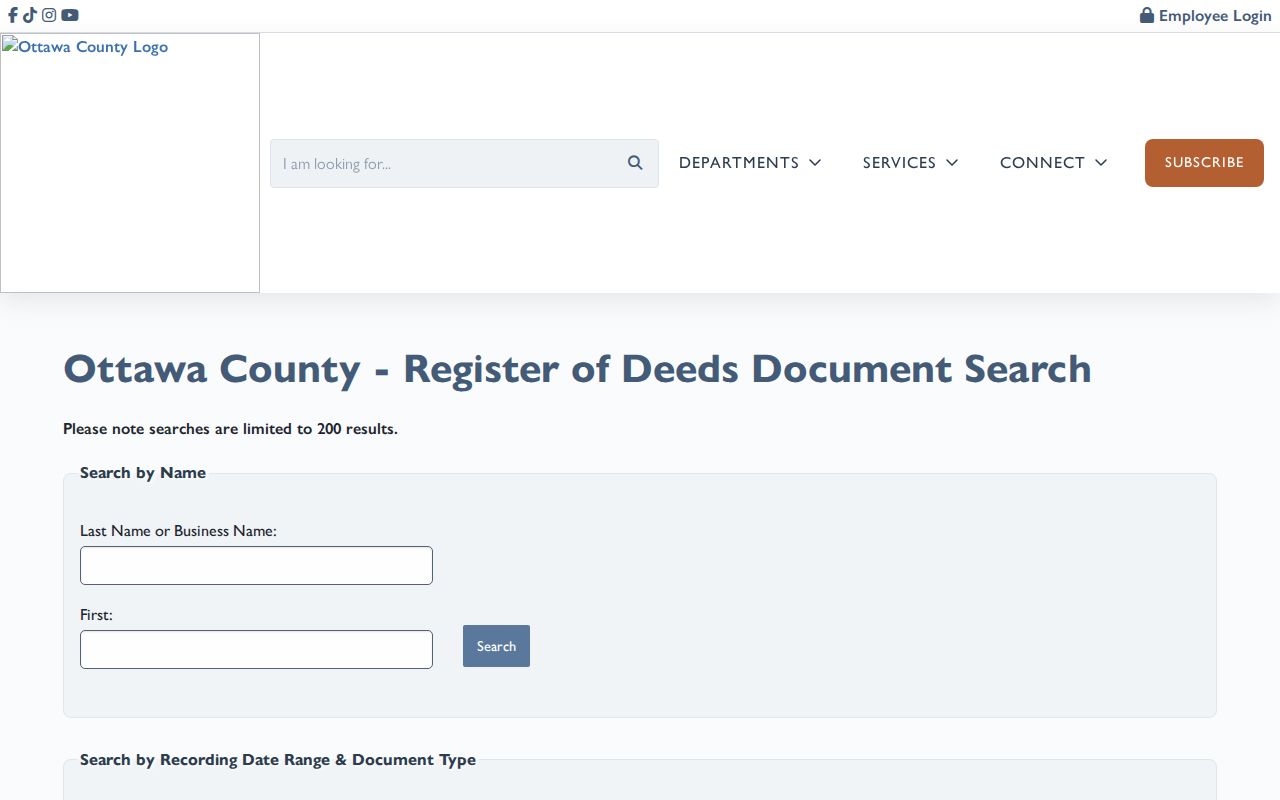
Use the image purchase only when the index result needs the underlying instrument, legal description, or party-role confirmation.
Limits of Georgetown Resident Records
A ZIP result, a voter match, a parcel owner, or a Principal Residence Exemption does not alone prove who lives in a Georgetown Township household. Postal, election, tax, and deed systems were built for different purposes. A mailing address can belong to a nonresident owner. A historical directory can omit spouses, children, or boarders. A court index may omit sealed or suppressed material. Treat each result as a dated statement from its custodian, then compare it with another record that answers the same identity question.
| Official record | Useful strength | Limit to remember |
|---|---|---|
| County parcel roll | Property, owner, and PIN connection | Owner is not a household roster |
| Recorded deed index | Dated instrument and party trail | Recorded party is not a current occupant |
| Unverified commercial listing | May suggest a lead | Can be stale, inaccurate, or combine people |
Georgetown Voter Record Routes
Michigan Voter Information Center is designed for an individual to check registration, polling-place, ballot, clerk, absentee, early-voting, and subscription information. Its name route requires first name, last name, birth month, birth year, and ZIP. It also has driver's-license and address routes. A no-match response directs the user to re-enter information or contact the clerk. The self-service response is not a public Georgetown roster and does not create a street-by-street browsing tool.
Michigan's Qualified Voter File request has a separate public-record route. A formal request can specify the state, county, township, district, school, village, ward, or precinct and can request listed history fields. Public QVF data can include name, residential and mailing address, year of birth, registration date, voter status, voter ID, and voter history. License or state-ID numbers, birth month and day, phone, email, digitized signature, and the last four digits of a Social Security number are exempt under MCL 168.509gg. Georgetown Township's clerk is the local election contact when a registration or precinct question needs help.
Note: A voter-history entry can show participation when properly requested, but it never reveals a person's ballot selections.
Jenison Labels in Georgetown Records
Georgetown Charter Township is not a city of Jenison. Jenison is an unincorporated community within the township, and older material may say Jenisonville, South Georgetown, Georgetown Township, or a nearby place name. An address can therefore carry a Jenison postal city, Georgetown Township government unit, and Ottawa County custodian at the same time. This is a common reason an otherwise sound name or address search appears to miss.
The main public ZIP is 49428, while 49429 appears as a postal channel in township material. Postal codes do not establish township lines, school districts, parcel jurisdiction, or election precincts. For a disputed address, preserve the USPS result, the county PropertyAddress and PropertyZip, the MailingAddress and MailingZip, GovernmentUnit, legal description, and the clerk's precinct response separately. Historic searches may need a plat, public-land-survey section, or old place-name variant rather than a modern city label.
Georgetown Vital Record Paths
For births, deaths, and marriages tied to Ottawa County, start with the county vital-record search and order service or the Clerk's office. The online page separates death records into 1867-1945, 1946-April 15, 2025, and April 16, 2025-forward bands. Marriage options are 1848-1912, 1913-October 28, 2019, and October 29, 2019-forward. The genealogy page also describes a West Olive self-service computer with deaths back to 1867 and marriages from 1905. Because the marriage descriptions differ, confirm the actual available band with the clerk before assuming a digital search covers a particular year.
County death and marriage copies list a $15 first or unique copy charge and $6 for an additional copy of the same record, with online technology or convenience charges where applicable. The county's genealogy mail search covers five years before and after a requested date and includes one certified copy if found. Recent birth records have stricter eligibility and identification rules. Michigan records registered from 1867 are also available through MDHHS, while earlier Georgetown research shifts to churches, cemetery records, family files, newspapers, county registers, the history room, and Archives of Michigan.
Georgetown History Room Leads
The Georgetown Township Public Library and Jenison Historical Association history room is the area's key local-history access point. The lower-level room connects researchers to in-library Ancestry Library Edition, MyHeritage through MeL, Grand Rapids Press obituary material, USGenWeb links, census, cemetery, church, school, yearbook, map, land, marriage, and township materials. Township information lists volunteer staffing on Wednesdays from 11 a.m. to 1 p.m.; confirm before making a trip because older JHA information described a different schedule. The library is at 1525 Baldwin Street in Jenison and lists 616-457-9620.
JHA maintains the room with the library and also preserves museum, newsletter, and community-history connections. Its 2025 annual-report material counted 18 open houses and 519 museum visitors, evidence that this is an active human-help route when a database search ends. Ask about an old street label, cemetery or obituary lead, map, township file, yearbook, or a directory title. The local page names directory resources but does not publish a verified year-by-year Georgetown shelf run.
Older Georgetown Resident Registers
Historic Georgetown Township records supply a resident trail even where a printed directory is absent. Archives of Michigan lists a voter registration book for 1859-1875, male voter registers for 1910-1924 and 1938-1944, and a men-electors register for 1920-1931. Georgetown tax rolls run from 1878 to 1947 in the listed archive material. County assessment-roll holdings include several nineteenth- and twentieth-century bands. These sources place a named voter, taxpayer, or landholder in a specific record series, not necessarily every person in a home.
Pair an archival register with local census links, deed and plat material, a cemetery or obituary item, and a vital record where appropriate. Georgetown's local-history links include federal census pages for 1850-1880, 1900-1910, 1920, and 1930, plus an 1884 state census. National images make the 1940 and 1950 federal censuses available as well. Historical spelling requires patience: Dutch and German compound surnames can appear as Van, Vander, De, or separate terms, while given names may be initials, nicknames, or middle names.
When Georgetown Portals End
An online no-result is often a signal to change access channels. For an Ottawa record, first contact the named custodian by phone or email and ask whether it is searchable at the counter, in the Register of Deeds research library, or in an archive. State the name variants, parcel number, address, record type, and date range. Request inspection before copies, then ask separately about certified copies if a legal document is needed. The county FOIA tracker requires an account for online submission, and other documented paths include mail, fax, and in-person requests.
Township permits and zoning materials are another example. Georgetown posts applications but no indexed public permit database was located. Ask for records by address or parcel and distinguish building, zoning, electrical, plumbing, mechanical, and right-of-way materials. Physical permit applications go to the township, with zoning review then routing to Professional Code Inspections. The same practical rule applies to older deeds: use the counter, research library, historic books or microfilm, Archives of Michigan, and formal inspection instead of guessing an online cutoff.
Historical Georgetown Resident Directories
Historical Georgetown resident directories need careful catalog work because no official source reviewed publishes a complete Georgetown or Jenison year-by-year run. The Library of Michigan holds city and county directories in print on second-floor south shelves, microfilm or fiche in the microfilm room, and licensed online formats through Ancestry Library Edition and HeritageQuest. Polk volumes can include suburbs beyond the title city. Bresser volumes, also called criss-cross directories, are built around street address and telephone information. An Ottawa County 1903-1921 listing is a regional catalog lead, not proof of complete Georgetown coverage.
A directory entry can supply a name, exact street address, occupation or business affiliation, spouse or other household notation, ownership or tenure mark, phone, and movement notation. Its date may describe information gathered the prior year. Compare the title's own abbreviations and editorial practice, then match the entry against a census, deed, tax roll, vital record, or obituary. The Georgetown Township city directories route focuses on these catalog leads, reverse-directory mechanics, and the historical shelf without treating a missing volume as a missing resident.