
Georgetown Township Sources for Previous Residents
The record trail changes with the era. A modern parcel and GIS result supplies the address continuity point, while deeds create the owner chain. Archives hold tax, assessment, voter, and mortgage records that precede online systems. A directory or census can place a dated household at an address, but Georgetown does not have a confirmed, complete local directory run. The right start is the source nearest the period in question, followed by a second record type that can test the connection.
| Source | Years it covers | Where held | What it can show |
|---|---|---|---|
| Current parcel roll and GIS | Current; historic GIS assessment layers include 2004-2007; split history reaches 1975 | Ottawa miOttawa and GIS | Owner, situs and mailing address, PIN, parcel shape, values, and parent/child splits |
| Register of Deeds index | Earliest online year not stated | Ottawa Deeds portal, counter, and research library | Grantor, grantee, instrument, book/page, parcel, and related document |
| Historic land material | Land sales from 1858; chattel mortgages 1852-1923 | Archives of Michigan and county sources | Earlier land and encumbrance trail |
| Georgetown tax roll | 1878-1947 | Archives of Michigan RG 2019-64 | Taxpayer, property context, and valuation, with incomplete years noted |
| Voter registers | 1859-1875; 1910-1924; 1920-1931; 1938-1944 | Archives of Michigan RG 2019-64 | Historical registered-voter context, not a complete household list |
| Local census pages | 1850-1880, 1884 state, 1900-1910, 1920, and 1930; federal 1940 and 1950 images are public | Local-history links, NARA, and FamilySearch | Household composition and residence in census geography |
Begin with the online parcel path for a recent address. For an older farm, lot, or village-era property, the legal description may be the better key. The county’s public deed page does not state where its online index begins. An empty search is not proof that an earlier record is gone. It may require the Grand Haven research library, the county counter, historic deed books or microfilm, Archives of Michigan, a plat, or an inspection request.
Georgetown Township Split History Before Deeds
Before working backward through previous residents, check whether the address stayed tied to one PIN. In Ottawa County Real Property Search, capture the FinalPIN, owner, situs and mailing addresses, legal description, government unit, subdivision or lot clues, latest sale, and PRE. If the search returns active and inactive parcels, compare any condo or unit fields and inspect the map. The county’s Split History screen records parent and child parcel links back to 1975. A split or combination may explain why an earlier deed does not use the PIN that appears today.
The county’s Split History record shows how a parcel can change while preserving a parent-child relationship. Read it before treating a failed deed search as a missing transfer.
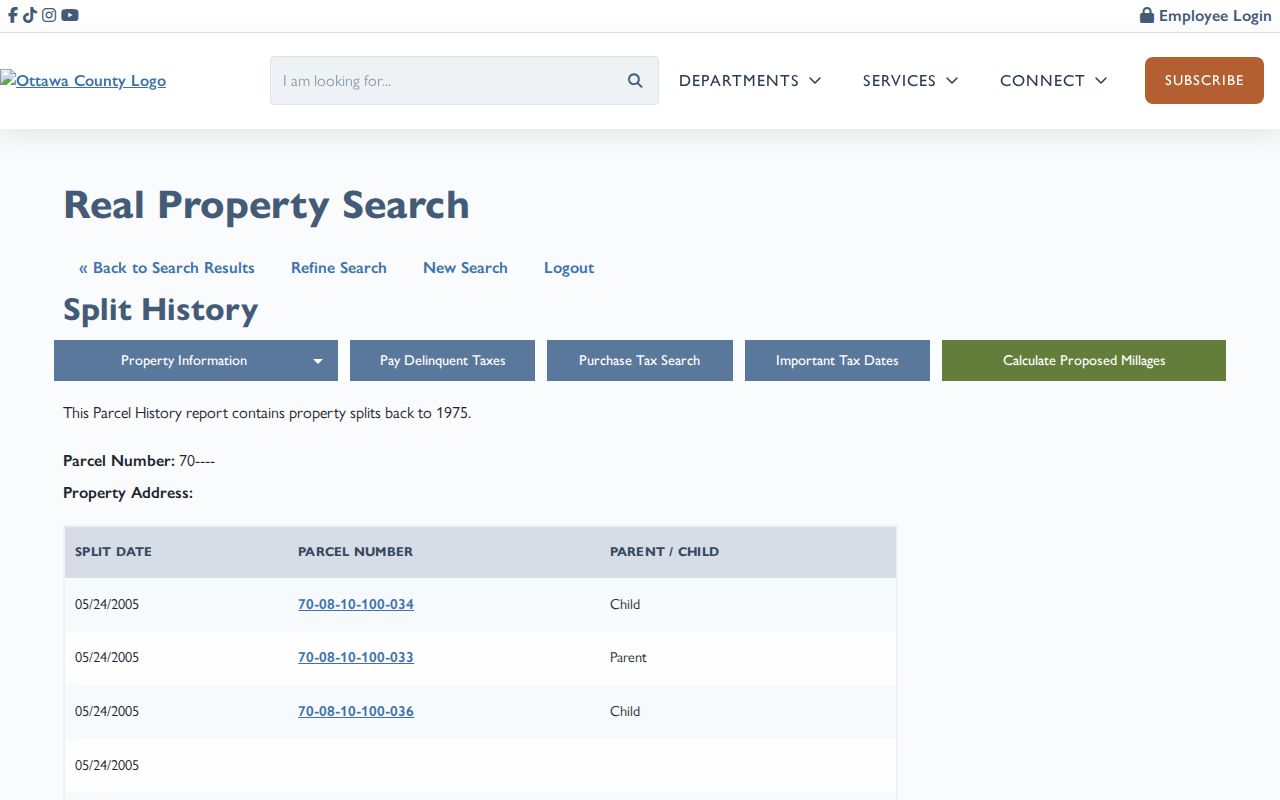
The parent and child rows provide an address-continuity checkpoint. Pair them with the legal description and map layers, because a new parcel number does not always mean the old address vanished.
Georgetown also has overlapping place labels. A record may say Jenison, Jenisonville, Georgetown Township, South Georgetown, or use a neighboring postal city. The public sources did not confirm a township-wide street-renumbering year. Search older street forms, plats, PLSS section and range, the old number, and the legal description rather than assigning a made-up renumbering date.
Georgetown Township Previous Owners in Deeds
The Ottawa County Register of Deeds search is the central owner trail for a Georgetown Township address. Start with the PIN or current owner, record the purchase deed’s date, parties, document number, document type, liber and page, parcel number, legal description, and related document. In a purchase, the current owner is usually the grantee and the seller is the prior link. Then search the seller as a grantee during an earlier period. Each recorded transfer should be read as a link, not as a claim that the grantee lived at the property.
- Find the current parcel in the property search and preserve its FinalPIN and legal description.
- Use the PIN in the deed index. If necessary, try the owner or business name and a small date range.
- Open the result and note Party 1, Party 2, record date, document number, type, liber/page, parcel, and related document.
- Identify the seller and search that seller as a grantee to locate the earlier acquisition. Repeat while the legal description continues to match.
- When the web index no longer produces a match, call the Register of Deeds at 616-994-4510, use the Grand Haven research library or counter, then ask about historic books, microfilm, plats, land records, or inspection.
- Grantor and grantee
- The grantor transfers an interest in a deed; the grantee receives it. Their role must be read in the specific document.
- Chain of title
- The ordered sequence of recorded transfers and related instruments affecting one parcel.
- Legal description
- The deed’s land description, such as a subdivision lot and block or survey description. It is often more stable than a street label.
- Liber and page
- A book and page reference that can lead to an older recorded document.
Index searching is free. Viewing, saving, or printing a document image costs $1 per page plus a convenience fee. The results are limited to 200, so narrow date ranges and related-document links matter. Instrument numbers containing the letter U do not have an image. The clerk cannot prepare legal documents or provide legal advice under MCL 600.916(1).
Georgetown Township Previous Residents Between Censuses
Ownership is only one layer of a prior-household search. Polk directories can show a resident name, occupation, address, other household members, tenure marks, and business listings. Their street sections are alphabetical and then arranged by house number. Bresser, also called criss-cross or cross directories, can lead from address back to a listed head of household and may show a phone number, tenure notation, first-listed year, arrival, or move notation. A directory usually reflects work gathered before the date printed on its cover, so check the volume’s own editorial practice.
- Choose a directory closest to the address era and copy the spelling, street number, spouse or household note, occupation, and publisher abbreviations exactly.
- Compare the result to the federal census immediately before or after it. Georgetown local-history links cover 1850-1880, the 1884 state census, 1900-1910, 1920, and 1930; federal 1940 and 1950 images are also public.
- Test the apparent move against a deed, tax roll, voter register, marriage or death record, probate file, obituary, cemetery record, or permit record.
- Search the previous and following directory volume before concluding that a household arrived or left in a particular year.
Georgetown’s local page names directory resources but does not publish a verified year-by-year Jenison or Georgetown sequence. The Library of Michigan offers print shelves, microfilm or fiche, and institutional online access; its guide says Polk directories may include suburbs. The Allen County Public Library catalog has an Ottawa County 1903-1921 lead, but that is not a confirmed Georgetown run. Use the Georgetown Township city directories route to check holdings and coverage title by title.
Note: A directory resident can differ from a parcel owner, and a directory’s absence can reflect its compiler’s coverage rather than a proven move.
Georgetown Township House-History Handoff
No dedicated Georgetown “research your house” guide was located. The practical help path is a combination of the Georgetown Township Public Library history room, the Jenison Historical Association, county deed research, Archives of Michigan, township maps, cemetery sources, and building or zoning files. The local-history resources connect researchers to in-library Ancestry Library Edition, MyHeritage through MeL, Grand Rapids Press obituary material, cemeteries, census, churches, land records, maps, schools, yearbooks, and township records.
The history room is in the lower level of the library and township building. Georgetown Township Public Library lists 1525 Baldwin Street, Jenison, MI 49428, 616-457-9620, and weekday hours with Wednesday volunteer staffing in the history room from 11 a.m. to 1 p.m. The Jenison Historical Association maintains the room with the library and lists P.O. Box 664, Jenison, MI 49429-0664 and 616-457-4398. Confirm the volunteer schedule before going. Ask for help bridging a modern address to an old place name, plat, tax roll, map, obituary, or historical directory rather than requesting a nonexistent complete street roster.
When a house was altered, the township’s building and zoning path provides another date layer. Georgetown’s residential application is a paper process at 1515 Baldwin Street; online or email submission is not accepted. Zoning review routes material to Professional Code Inspections at 1913 Baldwin Street, Jenison, 616-667-8803. Request public non-exempt records by address or PIN, ask separately for building, zoning, electrical, plumbing, mechanical, and right-of-way files, and use township or county FOIA if the necessary file is not posted.
Georgetown Township Maps and Archive Gaps
Historical maps can clarify land use and a lot’s relationship to nearby roads, but the records need an honest limit. A Library of Congress Sanborn search did not locate a Georgetown or Jenison edition. The nearest verified Ottawa County example is Zeeland, dated January 1934 to October 1944, six sheets. It should not be used as proof about a Georgetown structure. Search the Library of Congress database by place, state, and edition, then use its sheet count, notes, and digital-file information only for the place actually returned.
Archives of Michigan provides stronger Georgetown-specific records: chattel mortgages from 1852 to 1923, tax roll material from 1878 to 1947, voter registers, cemetery material, schools, naturalization files, and survey or land context. The 1831 survey map, plats, legal descriptions, and Ottawa GIS PLSS layers can bridge a modern address to the historical paper grid. Older records may describe land without a modern street number, which is why the parcel legal description is valuable.
For an end-of-trail question, use the Ottawa County Clerk and probate records, the Grand Rapids Press or Western Michigan Genealogical Society obituary index, cemetery sources, and current deed transfers. Death, marriage, probate, obituary, and cemetery records can connect an owner to heirs or a family chronology, but the original record should verify any index finding. Ottawa vital materials include death records from 1867 forward and separate marriage search bands; a certified record has its own eligibility and fee rules.
Georgetown Township Deed Access Choices
Ottawa’s deed search has a useful split: the online index is free, while document images are paid. That distinction matters when a Georgetown Township past-residents search needs only dates, parties, parcel numbers, and document references at first. It also prevents a deed-copy solicitation from setting the price. Compare any request with the county’s official Register of Deeds portal or call the office directly. The county’s Property Fraud Alert service is free and sends phone, text, or email notifications when a document is recorded under a subscriber’s name; it does not remove an existing instrument or prove fraud.
For a record that cannot be reached online, contact the custodian by phone or email, inspect it at the public counter or research library, and submit an Ottawa County FOIA request if it is a public record. State the name variants, parcel, address, record type, and date range. Ask to inspect before ordering copies and ask separately about certified copies. The county FOIA tracker requires an online account, but the request process does not erase statutory confidentiality.
Georgetown Township Previous Resident Limits
Previous-resident research is strongest when it reports what each dated record actually says. A current owner, a tax-mail recipient, a past taxpayer, and an occupant recorded in a directory may be different people. A mailing address can send the trail to another place, but it is correspondence evidence, not proof that the owner lived there. A non-owner occupant may appear in a directory or census and never appear on a deed. Conversely, an owner can be absent from a directory or represented by an estate, trust, or business.
Some information is protected or not a public resident source. Michigan Address Confidentiality Program participants may use a substitute public address. DMV information is restricted by the federal Driver’s Privacy Protection Act. QVF records have protected fields under MCL 168.509gg, and vital, juvenile, sealed, and expunged records follow their own limits. If a public record appears wrong, ask the particular assessor, clerk, court, GIS, or deeds custodian about its correction procedure rather than relying on a copied record.
Lawful personal use. Georgetown Township house-history research can support family history, estate questions, and property curiosity. It must never be used to stalk, harass, threaten, or harm a living person. Michigan stalking laws include MCL 750.411h, 750.411i, and 750.411s.