
Georgetown Directory Collection Leads
Georgetown Township’s historical shelf is a network of collections, not a documented sequence of volumes held in one place. The Georgetown local-history resources name directories alongside census, cemetery, school, land, church, obituary, and township material, but they do not publish an exact Georgetown or Jenison publisher-and-year list. That distinction matters. A catalog result for Ottawa County or Grand Rapids can be useful, yet it does not establish that every volume includes Georgetown households. Start with the local history room, then ask the Library of Michigan and regional repositories to check title-level suburban coverage.
| Collection lead | Years available or noted | Where held | How to use it |
|---|---|---|---|
| Georgetown federal census links | 1850–1880, 1900–1910, 1920, 1930 | Local History and archival sources | Use the transcription as a lead, then verify the image. |
| Georgetown and Ottawa voter or tax registers | Voter books 1859–1875; tax roll 1878–1947 | Archives of Michigan | Reference-room or archive-request trail for names and property context. |
| Polk and Bresser directories | Local exact run not published | Library of Michigan, regional libraries, and catalog leads | Check print, microfilm, or licensed database coverage volume by volume. |
| Ottawa County catalog lead | 1903–1921 | Allen County Public Library collection lead | Confirm title and Georgetown coverage before relying on it. |
| Yearbooks, obituaries, maps, and township files | Varies by item | Georgetown history room and partner collections | Use as companion evidence when a directory volume is missing. |
That limited shelf description is still useful. It keeps a researcher from inventing a directory year or treating an Ottawa County title as a Georgetown Township resident roll. The Library of Michigan’s directory guide explains that its state collection can be reached in print on second-floor south shelves, on microfilm or fiche in the second-floor microfilm room, and through Ancestry Library Edition or HeritageQuest. Its online guide also notes that Polk titles can include suburbs. Ask for the volume’s place coverage and publication date before copying an entry.
Georgetown History Room Directories
The Georgetown Township Public Library and the Jenison Historical Association provide the most local route when historical directory research stalls. The history room is in the lower level of the library and township building. Township and library information identifies volunteer staffing on Wednesdays from 11 a.m. to 1 p.m.; older association material lists different hours, so confirm the schedule before making a trip. The library’s regular hours are Monday through Thursday 9 a.m. to 8 p.m., Friday 9 a.m. to 6 p.m., and Saturday 9 a.m. to 1 p.m. The library is at 1525 Baldwin Street in Jenison and its phone is 616-457-9620.
The Jenison Historical Association maintains the room with the library and connects visitors with newsletters, tours, museum material, yearbooks, and local memory. Its contact information includes P.O. Box 664, Jenison, MI 49429-0664, and 616-457-4398. Bring the known spelling, address, date range, and any older place label, such as Jenisonville or South Georgetown. A volunteer can help locate a catalog lead, a map, an obituary index, or a township record, but should not be asked to infer facts from an absent volume.
The history-room partnership is shown in the local association material.
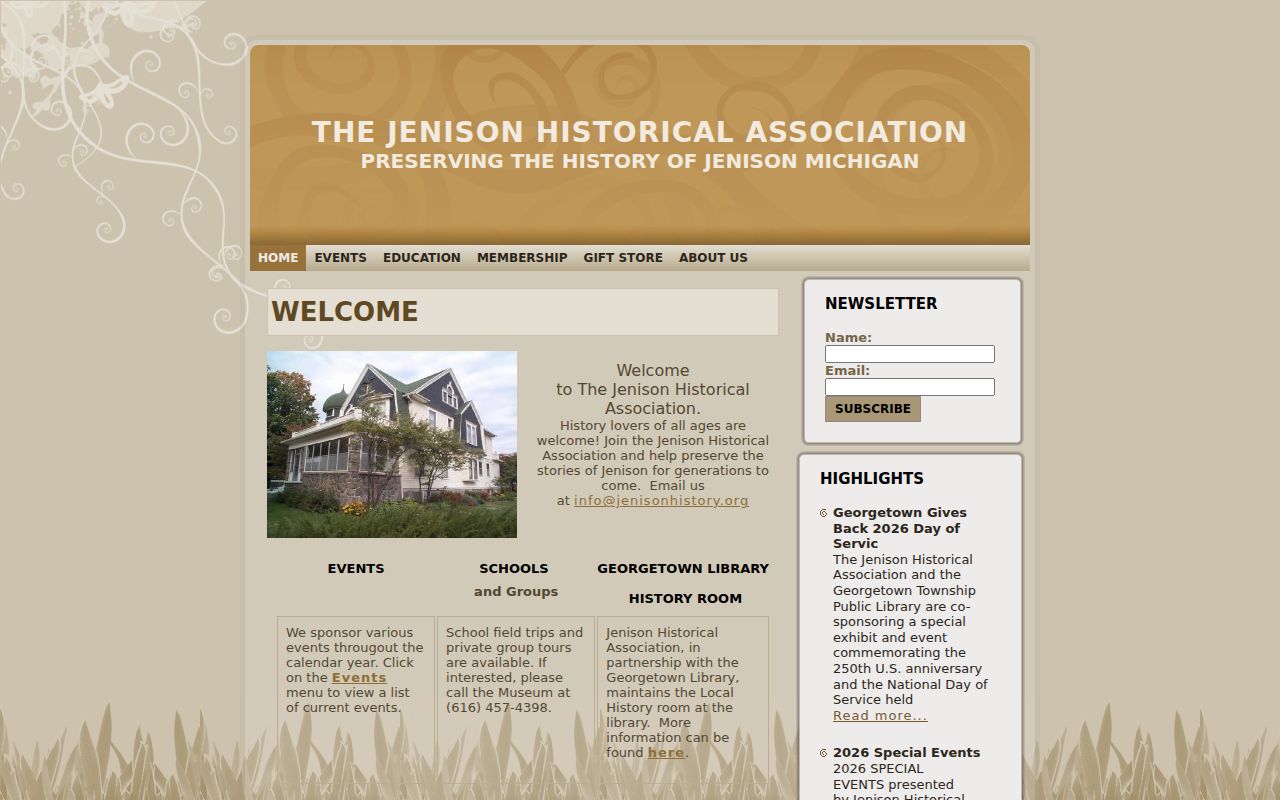
Use the room as a handoff from an online catalog to the physical record, especially when a directory reference needs an original title page, abbreviation key, or neighboring volume.
Reading Georgetown Directory Entries
A dated Georgetown directory entry is a snapshot prepared for a particular publication cycle, not a current identity record. Polk surname sections may show a resident name, occupation, other household members, ownership status, street address, and business listings. Its street section orders people and businesses by street name and house number. Bresser, often called a criss-cross directory, is built for the reverse question: address first, then heads of household, phone numbers, tenure notation, and sometimes new-arrival or move information. The volume’s date may describe people reached during the previous year, so read its editorial note.
| Name | Surname, given name, initials, and often the head of household. Women and children can be absent from street or telephone sections. |
|---|---|
| Address | Street and number, sometimes in house-number order. Compare it with an older place label or legal description when the modern address does not match. |
| Household clue | A spouse or other household member may appear, but absence is not proof that the person was absent. |
| Occupation or business | An affiliation that can help distinguish same-name people. It is dated evidence, not a current claim. |
| Tenure or phone notation | A publisher-specific mark or number. Read the key in that exact volume before expanding an abbreviation. |
- Criss-cross directory
- A reverse directory arranged by street and address, useful for locating a listed head of household at a historical address.
- Householder index
- A name-oriented listing that may identify the main listed person but not everyone living there.
- Abbreviation key
- The publisher’s explanation of short forms for occupations, tenure, and relationships. Photograph or transcribe it with the entry.
Georgetown Directory Publishers
The Library of Michigan city-directory guide describes Polk and Bresser as different tools, even when they cover the same larger area. Polk offers surname, street, telephone, and business pathways. Bresser adds a street-address and telephone emphasis, plus a building directory where included. Other publishers represented in the state collection include Robinson’s, Norton’s, Johnson Publishing, W.C. Bailey, and Luedder. The publisher name helps explain what the volume can show and which section to search first.
For an old Georgetown address, begin in a Bresser street section if the catalog confirms coverage. For a known family, start in a Polk surname section, then turn to the street section to see whether an address appears in house-number order. Neither format proves a parcel owner or every resident in a household. The record is strongest when its date, address, and household clues agree with a census, obituary, deed, cemetery register, or tax roll.
Georgetown Directory Catalog Checks
The Ottawa County 1903–1921 listing is a promising regional catalog lead, not a verified Georgetown Township run. The Allen County Public Library describes Polk print holdings from 1964 forward and city or county directory microfilm and fiche from the late 1700s through 1960. Its advice is practical: search the catalog by both city and county. A title that says Ottawa County may contain a useful local reference, yet coverage can be partial or limited to a named town.
Check the Library of Michigan ANSWER catalog, the state shelves or microfilm, the Allen County catalog and microtext card catalog, plus Grand Rapids, Grand Haven, and Holland titles for suburban inclusion. Record the title, publisher, printed year, section used, and repository. This catalog-check step corrects a common mistake: a record of a volume is not proof that a Georgetown person appears inside it. Note: The local-history page names directories but does not publish a first or last Georgetown directory year.
Trace Georgetown Directory Families
Use city directories to bridge the years between census releases. Georgetown’s linked federal census sequence includes 1850–1880, 1900–1910, 1920, and 1930, with an 1884 state census lead. The 1940 census is public, and the 1950 census was released in 2022. Choose a directory immediately before or after a census, copy the street, spouse, occupation, and address exactly, and compare the earlier and later volume. A move can then be tested with deeds, death or marriage records, probate, an obituary, cemetery records, or a tax roll.
- Find the earliest confirmed directory entry and preserve the title page with its date.
- Follow the name across nearby years, noting spelling, address, occupation, and household changes.
- Use the street or criss-cross section only after confirming the volume covers the locality.
- Pair the entry with the closest federal or state census, then compare the previous and next directory.
- Test a disappearance with an obituary, cemetery, vital record, deed, probate file, or tax roll.
A person may disappear because of a move, death, changed surname, incomplete compiler coverage, or a change in the directory’s territory. The record does not answer that question alone. For a modern property trail after an historical address has been identified, use the address records on the Georgetown Township street directory rather than treating a directory notation as a present ownership result.
Georgetown Directory Place Names
Place names are a real catalog problem in Georgetown Township. Jenison is an unincorporated community within the township, while older records can use Jenisonville, South Georgetown, or Georgetown Township. The township was established in 1840 and became a charter township in 1965. Older settlement, mill, farm, land, and road records may use township language where later directories or yearbooks use Jenison. Search all known forms, then compare the street with a plat, legal description, or public-land-survey section.
County history also explains why older official books may be found outside the township. Georgetown Township was considered as a possible Ottawa County seat in 1856, but Grand Haven remained the county center. Today’s offices are primarily in West Olive, Grand Haven, Holland, and Hudsonville. That split custody means a single family search may move from a Jenison history room to the county research library or the Archives of Michigan without any missing record being implied.
Georgetown Directory Companion Records
When a historical directory volume cannot be located, Georgetown’s local history sources offer other dated name trails. The township resources point to Grand Rapids Press obituary material, cemetery information, church and school leads, maps, early-settler material, land records, marriages, yearbooks, and township records. Archives of Michigan adds Georgetown voter registers, tax rolls, chattel mortgages, naturalization records, school material, and cemetery registers. These sources have different purposes, so label each fact by its source and date instead of combining them into one unqualified household story.
The Grand Rapids Press or Herald obituary index is a locator, not the original notice. Retrieve the newspaper item or funeral-home record to check dates, relatives, and address details. Georgetown and Hanley cemetery material can support a burial connection, but a plot purchase is not automatically an interment. School records have access limits, including a 75-year closure noted for Georgetown attendance and scholarship records unless a death certificate is supplied. Note: Historical records often answer a name-and-date question better than they answer a complete household question.
Georgetown Directory Access Routes
Use the online catalog before travel, but keep the full access chain available. Begin with the local-history room and the Library of Michigan guide. If a volume is not listed online, call the holding library, ask whether print, microfilm, fiche, or a licensed database contains it, and request a title-level check for Jenison or Georgetown coverage. In-library Ancestry Library Edition and MeL-supported MyHeritage are local digital options; they may require a library visit or account eligibility. The Jenison Historical Association can add local context and point to related township material.
For a missing historical record, the next channels are the Ottawa County Register of Deeds research library in Grand Haven, the county counter, an Archives of Michigan reference request, or a Michigan FOIA request for a non-exempt township or county record. Michigan FOIA, 1976 PA 442, generally calls for a response within five business days, with a possible ten-business-day extension. Ask to inspect first, give name variants and a date range, and separate a request for a certified copy from a request for research access. That approach preserves the boundary between a directory clue and the custodian’s official record.